

Choosing the right power bank can feel like balancing between a rock and a hard place. On one hand, you want a high-capacity charger that keeps your devices powered all day. On the other hand, you need something portable enough to slip into your pocket. This is where a power bank comparison becomes essential.
In this comprehensive guide, we’ll help you decide between capacity and portability based on your lifestyle—whether you’re a traveller, student, gamer, or business professional. Let’s dive into the key factors that make one type of power bank better suited than another.
Understanding Power Bank Capacity
Before comparing models, it’s important to understand what capacity means.
🔋 What Does mAh Mean?
mAh stands for milliampere-hour—a unit that measures electrical capacity. The higher the mAh, the more charge the power bank can store.
📊 Common Capacities:
- 5,000mAh: Ideal for emergency use; charges most smartphones once.
- 10,000mAh: Balanced choice; charges a phone 2–3 times.
- 20,000mAh+: High-capacity; charges tablets, laptops, or phones 5–6 times.
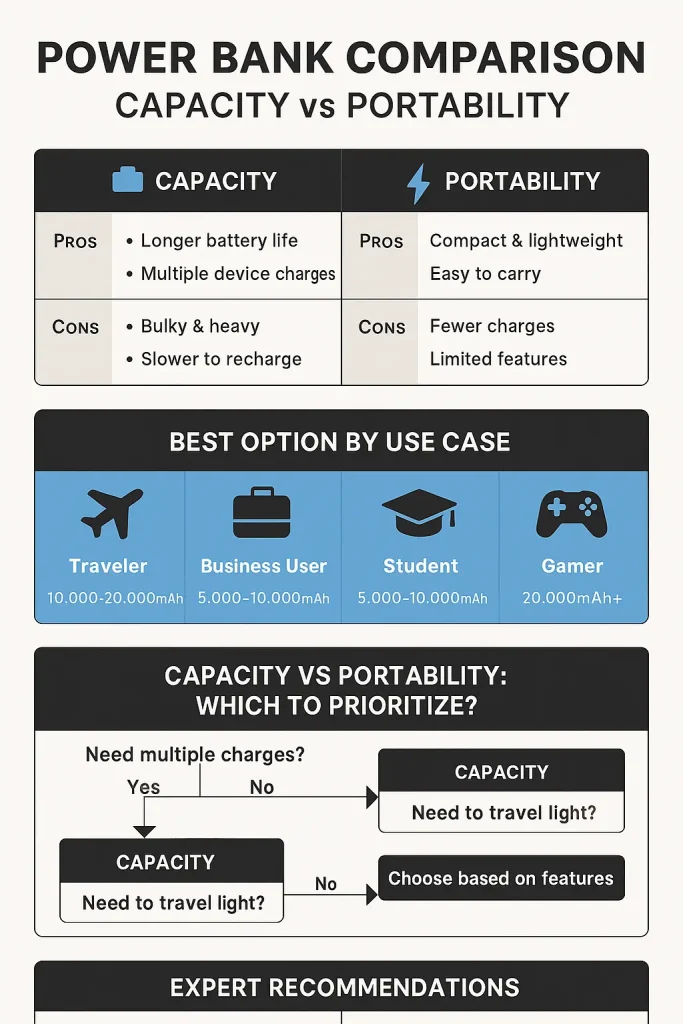
✅ Pros & Cons of High-Capacity Power Banks:
| Pros | Cons |
| Multiple charges | Heavier and bulkier |
| Great for long trips | Longer charging time |
| Can power laptops/tablets | Not pocket-friendly |
The Role of Portability in Power Bank Selection
A power bank’s portability isn’t just about size—it includes weight, design, and ease of carrying.
👜 Portability Factors:
- Size: Slim designs fit in small bags or pockets.
- Weight: Ideal models are under 250g for easy daily carry.
- Ports & Charging Speed: Some compact power banks sacrifice features like fast charging.
⚖️ Trade-Offs to Consider:
- Smaller power banks = less capacity
- More portability = fewer ports or slower output
- Bigger isn’t always better—especially if it’s inconvenient to carry
Power Bank Comparison by Use Case
✈️ For Travellers
Need: Long battery life, multiple device support, airline-safe
Ideal Specs:
- Capacity: 10,000–20,000mAh
- Dual USB or USB-C + USB-A ports
- Lightweight yet powerful (e.g., Anker PowerCore 20100)
💼 For Office or Business Use
Need: Sleek design, moderate charging, device compatibility
Ideal Specs:
- Capacity: 5,000–10,000mAh
- Ultra-slim body to fit in laptop bags
- Support for USB-C PD for quick top-ups during meetings
🎒 For Students and Daily Commuters
Need: Lightweight, affordable, quick phone recharge
Ideal Specs:
- Capacity: 5,000–10,000mAh
- Fast charging for short breaks between classes
- Compact enough for jeans or a backpack pocket
🎮 For Gamers and Heavy Users
Need: Long playtime, high-speed charging, device cooling
Ideal Specs:
- Capacity: 20,000mAh+
- Quick Charge 3.0 or USB-C PD
- Reliable brand with heat control and long battery cycles
Capacity vs Portability: Power Bank Comparison
Let’s break it down by priorities and needs.
🆚 Quick Comparison Table:
| Use Case | Capacity | Portability | Recommended |
| Traveler | High | Medium | 20,000mAh PowerCore Essential |
| Business User | Medium | High | 10,000mAh Slim USB-C |
| Student | Medium | High | 5,000–10,000mAh Mi Pocket Power Bank |
| Gamer/Heavy Use | Very High | Low | 26,800mAh Romoss or Baseus |
🔁 Flowchart Summary:
Ask Yourself:
- Do you charge more than once per day? ➡️ Choose High Capacity
- Do you hate carrying extra weight? ➡️ Choose Portability
- Do you travel or game a lot? ➡️ Opt for both, even if it’s heavier
Final Verdict: Best Power Banks by Use Case in 2025
Here are a few 2025 picks based on your needs:
- Best Overall: Anker PowerCore 20000 PD – Powerful, balanced
- Best for Portability: Xiaomi Mi 10000mAh Slim – Lightweight, fast
- Best for Laptops/Gaming: Baseus 30000mAh PD – Heavy-duty charger
- Best Budget Pick: Realme 10000mAh Power Bank – Affordable and fast
💡 Pro Tip: Always check for airline safety if travelling. Stay under 27,000mAh.
FAQs About Power Bank Comparison
🔌 What’s the ideal capacity for a traveller?
10,000–20,000mAh is ideal for travellers—enough for a couple of days without access to outlets.
💻 Can a small power bank charge a laptop?
Only if it supports USB-C Power Delivery (PD) and has a high output wattage (18W+), which most compact models do not.
⚠️ Are all power banks allowed on flights?
Most airlines allow power banks under 27,000mAh (100Wh). Always pack them in carry-on luggage.
⏱️ How long does it take to charge a high-capacity power bank?
Depending on input (USB-C or Micro-USB), charging a 20,000mAh power bank can take 4–10 hours.
Conclusion
When it comes to a power bank comparison, the right choice depends on your lifestyle. Capacity ensures longevity, while portability keeps things light and easy. Evaluate what you need most—power or convenience—and choose accordingly.
Whether you’re heading out on a trip, attending back-to-back meetings, or just commuting to class, there’s a perfect power bank out there waiting for you.